
Have Claude write an Aseprite extension that paints isometric worlds from brushes
by PaperChaseWebb
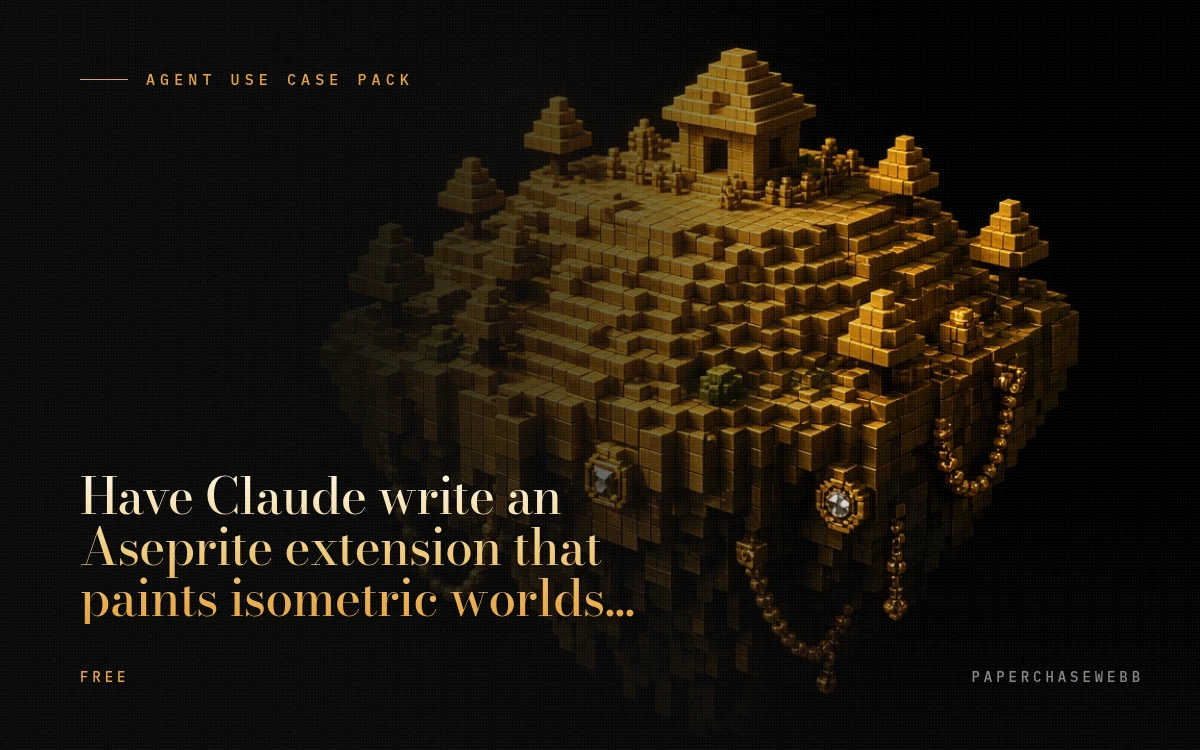
A game artist tired of hand-drawing hundreds of grass tiles spent a couple of weeks directing Claude to write the Lua for an Aseprite extension: SimCity-style brushes for hills, paths, ponds and trees that redraw only the area touched, with trees grown in 3D first and drawn back to pixels with the same camera.
- Price
- Free
- Difficulty
- Intermediate
- Setup
- 30 min
- Format
- .md file
have-claude-write-an-aseprite-extension-that-paints-isometric-worlds-from-brushes.md · 2 KB · direct download, no signup
What you end up with
His main point: the agent writes working code but has no taste of its own, so every 'make it look nice' needed him pointing at specific pixels.
What you get
- A plain-language summary of the workflow
- A fill-in prompt template
- What to watch out for
- A link to the original source
Who it is for
Builders who already use AI agents and want a proven workflow they can copy into their own project.
Works with
Solid chips: the agent is named in this listing's own tools list. Dashed chip: Plain Markdown, so it also pastes into other agents such as Grok Bot, Hermes, OpenClaw or Muse. We list those as compatible by format only, not as tested.
Tools needed
Cost to run: Free with the agent plan you already use.
Time to result: One working session
How it works
Describe the tool as brushes and the exact tiles each brush must produ
Describe the tool as brushes and the exact tiles each brush must produce.
Expected: Done before you move to the next step.
Ask for partial redraws so the tool stays live on large maps
Ask for partial redraws so the tool stays live on large maps.
Expected: Done before you move to the next step.
Keep one fixed test map and compare screenshots after every change
Keep one fixed test map and compare screenshots after every change.
Expected: Done before you move to the next step.
Point at exact pixels when something looks wrong instead of asking for
Point at exact pixels when something looks wrong instead of asking for nicer.
Expected: Done before you move to the next step.
Check the export in the game engine early, since coordinate mix-ups sh
Check the export in the game engine early, since coordinate mix-ups show up there first.
Expected: Done before you move to the next step.
Sample prompt from the pack
Apply this workflow to [your project]:
1. Describe the tool as brushes and the exact tiles each brush must produce.
2. Ask for partial redraws so the tool stays live on large maps.
3. Keep one fixed test map and compare screenshots after every change.
4. Point at exact pixels when something looks wrong instead of asking for nicer.
5. Check the export in the game engine early, since coordinate mix-ups show up there first.
Stop and ask me before anything irreversible: deploys, payments, sends or deletes.
Adapted by PaperChaseWebb. Not the original author's prompt.
Free preview of the file
# Have Claude write an Aseprite extension that paints isometric worlds from brushes

PaperChase agent use case (free feed entry), version 1.0. Source: [u/antahonist on r/vibecoding](https://www.reddit.com/r/vibecoding/comments/1xium30/im_a_mid_artist_so_i_made_claude_help_me_build_a/), 2026-10-29.

## What they did

He acted as the product manager: design, test, and say exactly what looked wrong. Hard parts included tile variants that did not line up because two coordinate systems were mixed, and Godot's terrain solver leaving broken corners on concave cliffs, which they fixed by placing tiles from corner pieces directly.

## Worth knowing

His main point: the agent writes working code but has no taste of its own, so every 'make it look nice' needed him pointing at specific pixels. Build a fixed test map so you can compare each change against the last one.
Worth knowing
- His main point: the agent writes working code but has no taste of its own, so every 'make it look nice' needed him pointing at specific pixels. Build a fixed test map so you can compare each change against the last one.
- Figures are as reported by the original author and were not re-measured by us.
Questions
Where does this come from?
A public post credited to u/antahonist on r/vibecoding. Source: https://www.reddit.com/r/vibecoding/comments/1xium30/im_a_mid_artist_so_i_made_claude_help_me_build_a/
Is it free?
Yes. Feed entries are free to read and download.
Details
Version 1.0 · Updated Oct 30, 2026 · Markdown version of this page
License: Personal and commercial use. Credit the original source when you share the workflow. Download terms
Related
AGENTS.md, CLAUDE.md and Cursor rules starter files
Six fill-in instruction files for coding agents (base, Next.js plus Supabase, FastAPI, browser game, CLAUDE.md pointer, scoped Cursor rules), an Approvals section that makes the agent stop and wait for your yes, a table of what Grok Bot, Claude Code, Codex, Hermes and Cursor each read, a read-only checker for your rule files and 9 prompts to write, trim and test your own.

Ask-first rules for AI agents: hard nos, approval cards and a test set
Paste-in rules that make an agent ask before it sends, spends, posts or deletes, define what a real yes is, and stop retries after a no, plus 12 test scenarios to check it.