
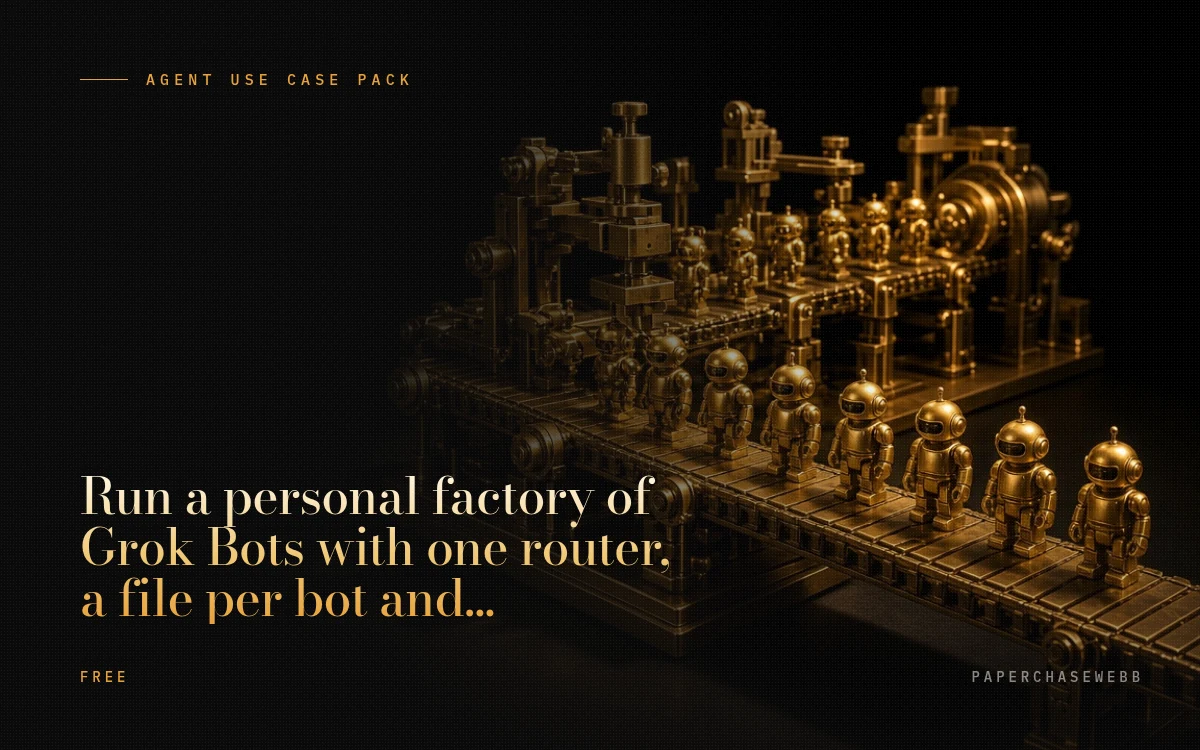
Run a personal factory of Grok Bots with one router, a file per bot and a nightly audit
by PaperChaseWebb
A long write-up on running many Grok Bots as a personal factory: one bot per job, a router bot in front, a BOT.md per bot, nightly backups and a maintainer audit, coding handed off to Claude Code or Codex, and a dashboard where approvals count only when they come from the source.
- Price
- Free
- Difficulty
- Advanced
- Setup
- 1 hr
- Format
- .md file
run-a-personal-factory-of-grok-bots-with-one-router-a-file-per-bot-and-a-nightly-audit.md · 3 KB · direct download, no signup
What you end up with
Two rules travel well to any multi-agent setup: keep each agent's state in one file another agent can read to resume it, and never accept a second-hand 'approved'.
What you get
- A plain-language summary of the workflow
- A fill-in prompt template
- What to watch out for
- A link to the original source
Who it is for
Builders who already use AI agents and want a proven workflow they can copy into their own project.
Works with
Solid chips: the agent is named in this listing's own tools list. Dashed chip: Plain Markdown, so it also pastes into other agents such as Grok Bot, Hermes, OpenClaw or Muse. We list those as compatible by format only, not as tested.
Tools needed
Cost to run: Free with the agent plan you already use.
Time to result: One working session
How it works
Give each bot one job and a BOT.md: rules, routines, credential names
Give each bot one job and a BOT.md: rules, routines, credential names only, state, lessons and resume steps.
Expected: Done before you move to the next step.
Put a router bot in front that sends each request to one bot and logs
Put a router bot in front that sends each request to one bot and logs it.
Expected: Done before you move to the next step.
Keep a versioned operating manual and record which version each bot la
Keep a versioned operating manual and record which version each bot last read.
Expected: Done before you move to the next step.
Schedule a nightly backup and a maintainer audit that reports drift
Schedule a nightly backup and a maintainer audit that reports drift.
Expected: Done before you move to the next step.
Count approvals only when read from the approvals source, never from a
Count approvals only when read from the approvals source, never from a bot's message.
Expected: Done before you move to the next step.
Sample prompt from the pack
Apply this workflow to [your project]:
1. Give each bot one job and a BOT.md: rules, routines, credential names only, state, lessons and resume steps.
2. Put a router bot in front that sends each request to one bot and logs it.
3. Keep a versioned operating manual and record which version each bot last read.
4. Schedule a nightly backup and a maintainer audit that reports drift.
5. Count approvals only when read from the approvals source, never from a bot's message.
Stop and ask me before anything irreversible: deploys, payments, sends or deletes.
Adapted by PaperChaseWebb. Not the original author's prompt.
Free preview of the file
# Run a personal factory of Grok Bots with one router, a file per bot and a nightly audit

PaperChase agent use case (free feed entry), version 1.0. Source: [Roy Osherove (@RoyOsherove)](https://robotpaper.ai/anatomy-of-a-personal-factory-of-grok-bots/), 2026-10-28.

## What they did

The author splits work into one bot per job with a router bot that takes requests and pushes them to the right bot. Each bot keeps a BOT.md with its rules, memory notes, routines, the names (not values) of the credentials it uses, state, lessons and how to resume. A versioned operating manual is shared across the fleet and each bot records which version it last read. A backup runs at 3 AM and a maintainer bot audits the fleet afterwards; a security bot checks each night for planted agent instruction files. Coding jobs go to Claude Code or Codex, and a hook at the end of their turn posts back to the bot. The dashboard shows decision cards, and an approval counts only when it is read from the approvals system, not when a bot says it was approved. He also lists what is still missing: delivery receipts, routine prompts kept as files, and automatic restart after a crash.

## Worth knowing

Two rules travel well to any multi-agent setup: keep each agent's state in one file another agent can read to resume it, and never accept a second-hand 'approved'. The gaps list is as useful as the design. The author mentions trying OpenClaw, Hermes and Muse before settling on this setup.
Worth knowing
- Two rules travel well to any multi-agent setup: keep each agent's state in one file another agent can read to resume it, and never accept a second-hand 'approved'. The gaps list is as useful as the design. The author mentions trying OpenClaw, Hermes and Muse before settling on this setup.
- Figures are as reported by the original author and were not re-measured by us.
Questions
Where does this come from?
A public post credited to Roy Osherove (@RoyOsherove). Source: https://robotpaper.ai/anatomy-of-a-personal-factory-of-grok-bots/
Is it free?
Yes. Feed entries are free to read and download.
Details
Version 1.0 · Updated Oct 29, 2026 · Markdown version of this page
License: Personal and commercial use. Credit the original source when you share the workflow. Download terms
Related
AGENTS.md, CLAUDE.md and Cursor rules starter files
Six fill-in instruction files for coding agents (base, Next.js plus Supabase, FastAPI, browser game, CLAUDE.md pointer, scoped Cursor rules), an Approvals section that makes the agent stop and wait for your yes, a table of what Grok Bot, Claude Code, Codex, Hermes and Cursor each read, a read-only checker for your rule files and 9 prompts to write, trim and test your own.
Ask-first rules for AI agents: hard nos, approval cards and a test set
Paste-in rules that make an agent ask before it sends, spends, posts or deletes, define what a real yes is, and stop retries after a no, plus 12 test scenarios to check it.