
Agent-Ready Storefront Check: can an AI agent find, read and buy from your store, and which file fixes it
by PaperChaseWebb
Fifteen read-only checks on the folder your build writes and the repo behind it, not a live URL: robots.txt and an export of your CDN or firewall bot rules let agent shoppers reach product and checkout pages, llms.txt links every machine-readable file, Product JSON-LD and prices agree, every paid page has a real checkout link, buy controls are links or buttons, no CAPTCHA sits on a product or checkout page, and policies are linked. Every finding names the source file to change. Source edits wait for the owner's yes; checkout and bot rule changes stay with the owner.

- Price
- $19
- Difficulty
- Intermediate
- Setup
- 1 hr
- Format
- .md file
agent-ready-storefront-check-can-ai-agents-buy-from-your-store.md · 135 KB · instant download after checkout
Want this built for you instead? We can build it for you.
What you end up with
You know what stops an agent shopper on your store, the source file behind each problem, and which fixes only you can make; and no source file changes without your yes.
What you get
- 21 sections in one .md file, with a one-line unpack
- The five steps an agent shopper goes through (let in, find, read and trust, reach checkout, pay without a puzzle), with the checks that sit on each
- How to export your CDN or firewall bot rules into a small file the check reads, and a one-page worksheet
- The check folder: storefront.json with a source map, bot-rules.json, fixes, approvals and done, with blank templates
- store.py: gate (exit 0, 11, 12), a scan that turns findings into fixes naming the file to change, a report grouped by file, owner approval tied to a sha256, verify and one use per yes
- storefront_check.py: fifteen read-only checks, with a seeded test store (15 findings, then 0) and the unit tests
- A skill file for Claude Code, Codex and Hermes, an AGENTS.md snippet and a Grok Bot rules block
- Ten prompts, a failure table, a worked example on a made-up tea shop, the check run read-only on our own store, and a look at other agent readiness checkers with sources
Who it is for
People who sell from a site they build themselves and want agent shoppers to reach the checkout, with fixes pointed at the repo rather than a score on a live page.
Works with
Solid chips: the agent is named in this listing's own tools list. Dashed chip: A skill file for Claude Code, Codex and Hermes, an AGENTS.md snippet and a Grok Bot rules block; the scripts were tested on Linux with Python 3.13, the agent files were not loaded inside each harness and no real agent shopper was run against a store.
Tools needed
Cost to run: The pack is the only purchase. The scripts use no model tokens; drafting fixes with an agent uses its usual tokens.
Time to result: A first report in an afternoon, with the build folder, repo and CDN dashboard open
How it works
Run the tests
Unpack the pack with the one-line command in section 8 and run sh test_all.sh.
Expected: 15 findings on the seeded store and 0 on the fixed one, 15 of 15 single faults caught alone, checker tests 76 passed, store.py tests 45 passed, exit 2 on a missing folder.
Describe your store
Run store.py init, then fill storefront.json: the built site folder, the repo, your origin, the product page pattern, the machine-readable files you publish, and a source map from built files to the files that make them.
Expected: The checker reads your build and every finding has a change: line, or A15 tells you which source map row is missing.
Export the bot rules
Copy your CDN or firewall bot rules into bot-rules.json by hand, in order, as section 6 shows, or write none-in-front with a note if nothing sits in front of the site.
Expected: A12 reads the rules the way your CDN applies them, first match wins.
Scan, report, get the yes
Run store.py scan and report and read report.md together. The owner ratifies the rules and approves each source edit at their own terminal; checkout links and bot rules are changed by hand.
Expected: A report grouped by the file to change, every source edit tied to the owner's yes, and a rerun with 0 findings.
Sample prompts, free to use
Read my build script and the built site folder. Fill source_map in storefront.json so every built file the checks read points at the file that writes it, most specific pattern first. Do not edit anything else. Run storefront_check.py and tell me which A15 rows are still missing.
Prompt 2 of 10.
Run store.py scan and store.py report on the check folder. Tell me, file by file, what to change and why an agent shopper gets stuck there. List separately what only I can do: checkout links and CDN or firewall rules. Draft nothing until I say which file.
Prompt 4 of 10.
Draft the edit for fix F3 only, as a diff against the source file it names. Run store.py verify first; if it does not exit 0, stop and tell me the hash to approve. After the edit, rebuild, rerun the check and mark it done.
Prompt 6 of 10.
Free preview of the file
# Agent-Ready Storefront Check: can an AI agent find, read and buy from your store?

Version 1.0, 2026-10-29. By PaperChaseWebb. A check for stores and product sites you build yourself, run on the folder your build writes and the repo behind it, before anything goes live. Fifteen read-only checks cover what an agent shopper needs: to be let in, to find a list of what you sell, to read a name and a price it can trust, to reach a real checkout, and not to be stopped by a CAPTCHA or a bot rule on the way. Every finding names two files: the built file the check read, and the source file to change. There is no score out of 100. A script turns the findings into a fix list and a report grouped by the file to open, gates what an agent may do, and records the owner's yes before any source file is edited. Checkout settings, CDN and firewall rules, and deploys stay with the owner, by hand. Python 3 standard library only, no network. Works with Claude Code, Codex and Hermes through a skill file and an AGENTS.md snippet, and with Grok Bot through a rules block. Tested as described in section 13 on Linux with Python 3.13, including owner approvals typed at a pseudo-terminal, and run read-only on the local build of our own store (section 17). The agent files were not loaded inside the harnesses for this release and the check was not run against any live site. Each is marked where it matters.

The checkers you can run today mostly take a URL. They crawl the live page, give a score, and some
Test record
- Date
- Oct 29, 2026
- What was run
- storefront_check.py on a seeded store and a fixed copy, each planted fault alone, a missing input, and the unit tests. Linux, Python 3.13.
- Result
- 15 findings on the seeded store, 0 on the fixed one; 15 of 15 planted faults caught alone; exit 2 on missing input; nothing written. 76 checker and 45 store.py tests passed, 0 failed.
- Not run
- A real agent shopper against a store. The agent files inside Claude Code, Codex, Hermes or Grok Bot. Windows and macOS.
Copied from this item's dated test notes. What was not run stays in.
Worth knowing
- No real agent shopper (ChatGPT, Claude, Perplexity or any other) was run against a store. The checks test what those agents publish that they need; passing them does not promise that any agent will buy.
- A12 reads an export you make by hand from your CDN or firewall dashboard. If the export is out of date or incomplete, the check is too. The pack does not log in to any CDN.
- The pack works on stores you build into a folder of static files. Hosted shop platforms where you cannot read the built files or the source are out of scope.
- The pack makes no claim about sales, traffic or search ranking.
- The skill file, AGENTS.md snippet and Grok Bot rules block were not loaded inside Claude Code, Codex, Hermes or Grok Bot. Linux only; Windows and macOS were not tested. The scripts open no network connection.
- The approval step refuses piped input and the environment variables Claude Code, Codex, Hermes and Grok Bot set. That stops an agent approving its own edit; it is not a lock against someone with the same account.
- On 2026-10-29, on Linux with Python 3.13: storefront_check.py gave 15 findings on the seeded store (each check once) and 0 on the fixed one, caught 15 of 15 single faults with only its own check, wrote nothing, and exited 2 on a missing folder, missing storefront.json or broken storefront.json; checker tests 76 passed, 0 failed; store.py tests at a pseudo-terminal 45 passed, 0 failed.
Questions
Why not just check the live URL?
A live check finds the problem but not the template that causes it, and a crawler can be stopped by the same bot rules it is looking for. This check reads the build and the repo, so every finding names a file, and you can run it before anything goes live.
Does it tell me to unblock every bot?
No. Blocking training crawlers is your call. A02 and A12 only look at the agents you list, on product and checkout paths, so an agent a customer sent can still reach the checkout.
How is this different from the Agent Readiness Self-Check?
The free self-check asks whether your business is ready to hand work to agents. This pack checks whether agents acting for customers can buy from your store, and points each fix at a file. They link to each other rather than repeat.
Will an agent change my checkout or firewall?
No. Checkout links, CDN and firewall rules, deploys, posting and spending are owner-only or never. The agent drafts source edits, and each one waits for your yes.
Details
Version 1.0 · Updated Oct 29, 2026 · Markdown version of this page
License: Use for your own stores and for checks you run for clients. Do not resell or republish the pack itself. Download terms
Related
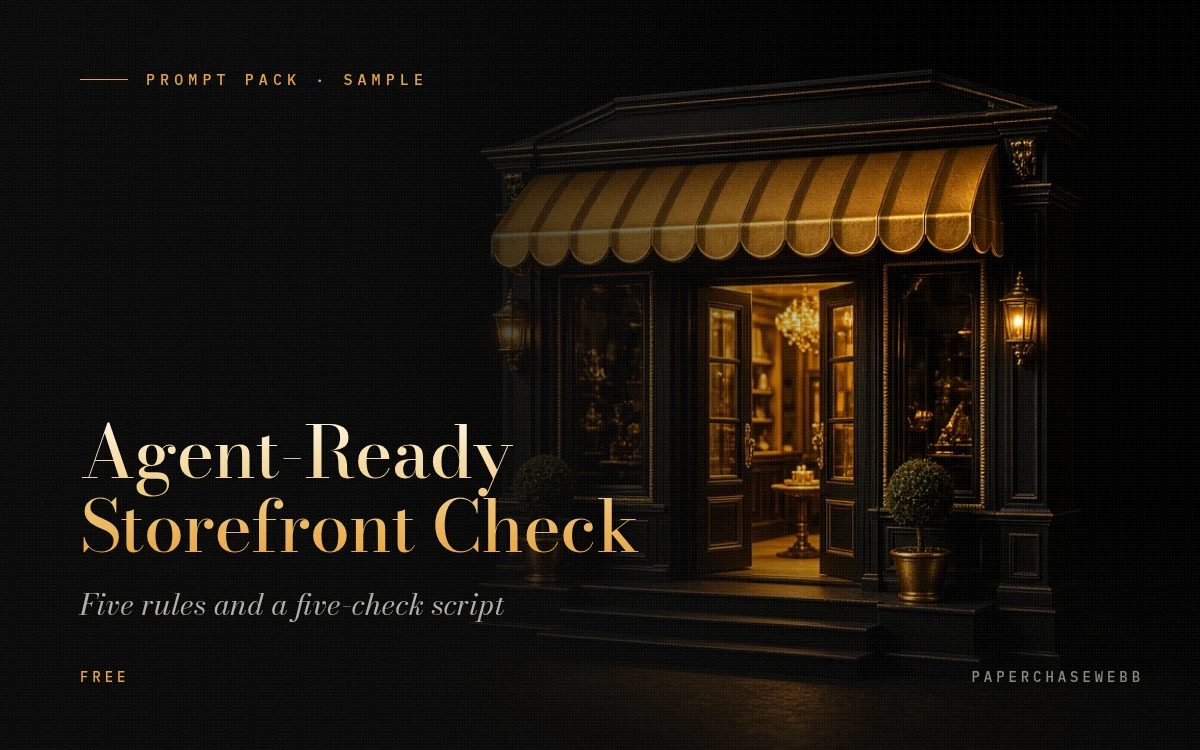
Agent-Ready Storefront Check: five rules and a five-check script (free sample)
From the Agent-Ready Storefront Check: five rules for a store agent shoppers can use (let the agents in, link every machine-readable file from llms.txt, Product JSON-LD with a price, a real checkout link on every paid page, no CAPTCHA on product pages), and a read-only script that checks your built site folder for them.

Agent Readiness Self-Check: score one workflow before you hand it to an AI agent
A free self-check for agencies and small businesses. Name the decision, then score one workflow across eight areas (workflow mapped, data access, approval gates, owner per agent, handoffs, cost tracking, security and vetting, measurement) with an evidence rule, three gate rules and a skeptical pass, and read your band and the next steps it allows. v1.1 starts with the decision the score will change, scores unknowns as unknown, adds rules for conflicting facts and lookalike public records, ties every band to the next steps it allows with the Production Readiness Audit before go-live, makes owner approval concrete (prepared and approved status, a one-reply approval line, decisions the agent must leave open, a done test), adds agent files for Grok Bot, Claude Code, Codex and Hermes, a second worked example (missed call to booked job), a readiness folder with a fifteen-check read-only checker, a front door test with four questions to ask anyone selling you an agent install, and a plain note on how it was tested. Still free.
Production Readiness Audit: decide from evidence whether an agent system can go live
Twelve areas, each pass, gap or na, and every pass points to a dated evidence file. Gaps get a named owner and a due date, five areas block go-live until fixed, drills are run rather than described, and the verdict is signed by someone who did not build the system. A fifteen-check script reads the folder, the report is sealed to a hash of the evidence, and the owner's go-live yes is tied to the report's sha256.
Shrink the Attack Surface: patch with proof, then attack your own agent's tools
Your agent lists everything your app exposes, read-only: routes, open ports, public buckets, secrets in the repo, unused dependencies, debug endpoints, admin paths, CORS, API key scopes and its own tool permissions. You decide keep, remove or lock for each. Every fix gets a proof that fails before the change and passes after it, and the proof stays as a regression test. Then attack drills run against your agent's own tool gate, offline: pressure, impersonation, injected tool output, stale and non-owner approvals and a failing tool. Each is judged by what the tools actually did, and every drill that gets through becomes a test that fails before the fix and passes after. A failing tool stops at a retry budget and asks you, and every approval is yours, typed at your own terminal and tied to a sha256.

Evidence Standard: what counts as proof for each kind of agent work, who checks it, and what is refused
Agents report done from the plan as often as from the result. Five plain files write down, for each class of work, the proof that counts, who checks it (never the producer), what is refused and how long proof is kept. Agents log each claim with its evidence, seal it by sha256 and report in the words evidence.py say allows: done, partly done with the gap named, waiting on the owner, or reported, not verified. The agent's own summary is never proof. Fifteen read-only checks run on the standard and the claims ledger.

Agency Install Kit: install one agent workflow in two weeks, with a binder a script can check
Five paid packs and the free Readiness Self-Check, tied into one two-week install by a new Install Binder: plain files for readiness, one workflow, agent owners and tested pauses, a gate register, a reach inventory, a cost cap, a dry run with refusal cases, a scorecard with kill rules and a run sheet with an off switch. A fifteen-check script names every missing decision, and the owner's go-live yes is tied to the binder's sha256.
AI Answer Visibility Check: does an assistant name you when a buyer asks, and who gets named instead
Ask each buyer question three times per assistant in fresh chats, paste the answers, and get a dated record of where you were named, where you were missed, who was named instead and which sources each answer cited. Fifteen read-only checks keep it honest: no brand in the question, three runs before a gap, answers hashed as given, nothing older than a month treated as current, and only your own brand. Page changes wait for the owner's yes.