
Free .md downloads, page 5
Starter playbooks, templates and prompt packs you can download in full, no signup. The free tier of the product line.
Port a console emulator to the browser with a rulebook, a headless test build and pixel checks
Two builders used Claude to port the PCSX2 PlayStation 2 emulator core to the browser. They kept a CLAUDE.md and AGENTS.md rulebook, had Claude build a headless version that boots and benchmarks on its own after every change, and required pixel-identical output for every optimisation.
Ground a coding agent in service manuals before it builds a mechanical recreation
A builder recreated an airport split-flap departure board in the browser with Claude Code. Before any code, research skills pulled real specifications from the manufacturer's old service manuals, patents and teardowns; then the board was built module by module with browser tests that click through it.

Build a cozy Godot game with Codex in a week, then keep adding to it
A long-time coder made a no-combat exploration game in Godot with Codex writing the code and AI making the images and music, with Meshy turning images into 3D models. The core loop took about a week and is out on itch with a Steam page coming.
Show reviewers the effect of an agent's action, not the agent's story about it
A post compares two approval screens for the same agent action: a sentence explaining why, versus the action, record, amount, before and after values, the policy rule that triggered review, whether it can be undone and the source ticket. The second can be judged in seconds from facts.
Route a coding agent's questions by the kind of decision, and log every answer
A team building a business system with coding agents has the agent stop and ask, with options, when a task runs past its spec. Questions about product direction, rule exceptions or loosening a check go to a person; routine design calls are answered from written rules and earlier rulings. In one week, 762 questions, 59 answered by the owner.
Check the whole MCP session, not just each tool call, for the untrusted input plus private data plus outbound mix
A post on r/mcp argues that per-call guardrails miss leaks made of two allowed calls, citing the case where a support ticket told an agent with a service role key to read a tokens table and post it back to the ticket. The fix is to break the combination of untrusted input, private data and an outbound channel per session.
Stop a browser agent clicking the wrong thing after the page changes under it
A team building a shared human and agent browser tags every agent action with who is driving the tab and the page revision the plan was based on. If either changed, the action fails as stale and the agent re-reads instead of clicking whatever is now at that spot.
Test a token-saving prompt against hidden tests before you adopt it
One builder ran a popular 'save tokens' prompt for Claude Code over 32 runs with hidden tests. Total cost fell about 9 percent on Opus and 6 percent on Sonnet, up to 20 percent on review tasks and close to zero on bug fixes, with the same quality. Most of the cost was reading code, which the prompt barely touched.

Replicate Before You React: a claim card, five rules and a rate script (free sample)
From Replicate Before You React: a ten-line claim card to fill in before you test a claim about your agent, five safety rules (canary never payload, throwaway environment, one capped key, a control arm, say what you ran) and a script that shows how much a handful of runs can actually tell you.
Compounding Offer Audit: five rules and a five-check script (free sample)
From the Compounding Offer Audit: five rules for scoring an offer on six tests (one owner, six scores and no total, a fact for every score, no 3 on say-so, one change on the weakest test), and a read-only script that checks one small file for them.
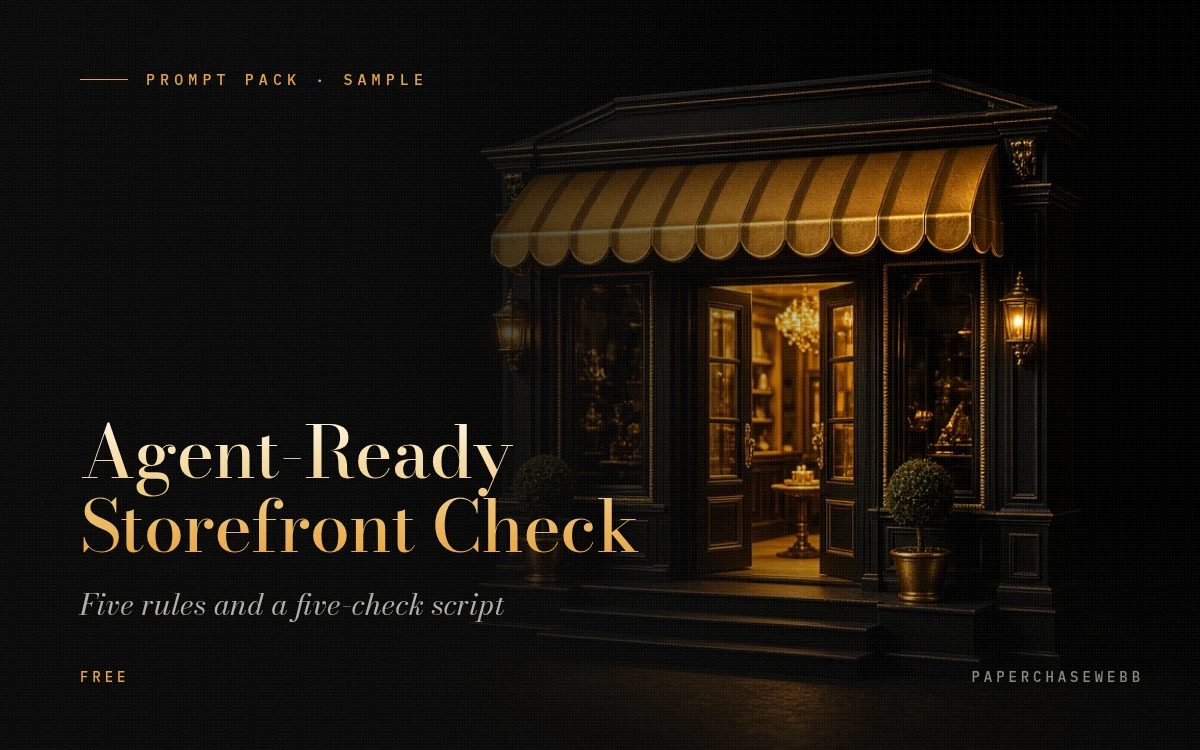
Agent-Ready Storefront Check: five rules and a five-check script (free sample)
From the Agent-Ready Storefront Check: five rules for a store agent shoppers can use (let the agents in, link every machine-readable file from llms.txt, Product JSON-LD with a price, a real checkout link on every paid page, no CAPTCHA on product pages), and a read-only script that checks your built site folder for them.
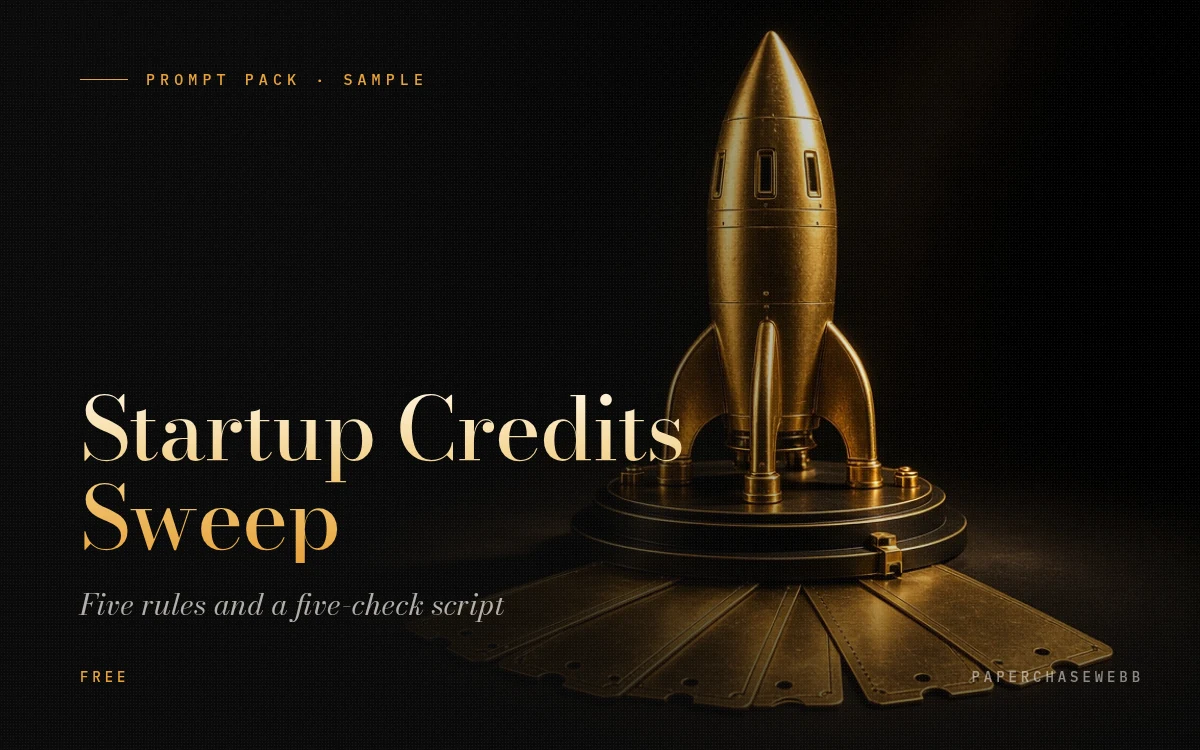
Startup Credits Sweep: five rules and a five-check script (free sample)
From the Startup Credits Sweep: five rules for going after startup credits honestly (facts first, the program's own dated page, apply only when every requirement is met, answers say your facts word for word, count credits only after approval and set a reminder before expiry), and a read-only script that checks one small file for them.

Research Desk: five rules for research you will act on, and a five-check script (free sample)
From the Research bundle: five rules for research that feeds a decision (an owner and an auditor who did not do the research, a decision named for every question, one of five verdicts per claim, a date on every source, a primary source behind every CONFIRMED), and a read-only script that checks one small file for them.
AI Answer Visibility Check: five rules and a five-check script (free sample)
From the AI Answer Visibility Check: five rules for checking whether assistants name you (leave your name out of the question, a fresh chat each time, three runs before you call it, save the answer as it came, change your own pages with your own yes), and a read-only script that checks your saved answers.
Capability statement ground rules and a five-line fact check (free sample)
From the Veteran GovCon AI Kit: the ground rules that keep an agent to your own facts when drafting a capability statement, and a five-line manual check for code shapes, contact details, hype words and dated status lines.

The Go AGENTS.md (free sample)
One of the twelve files from the stack-specific pack: an AGENTS.md for a Go repo with real commands, Go rules, the go.sum trap, ask-before and never lists, and an approvals rule.
The scope-of-work skill and template (free sample)
One of the five skills from the Consultant and Agency Skills Pack: a scope-of-work skill with a template that gives every deliverable a done test and an out-of-scope list, drafts only and asks for missing facts.
The job search AGENTS.md (free sample)
The rules file from Job Search Setup: truth rules that keep every claim to your master resume, and hard nos on applying, sending messages or logging in to job sites.
brand.md and the month-plan skill (free sample)
Two pieces of the Small Business Social Agent Pack: the brand.md facts template and the month-plan skill that writes a month of posts into a spreadsheet with an Approved column only you fill in.
Check your machine for the backdoored Claude Code editor extension and clean up properly
For about eleven hours on Oct 29, Cursor's extension marketplace served a tampered build of the Claude Code extension (2.1.313) to up to 5,000 users. It added an SSH key and startup persistence that survive uninstalling the extension, so the fix is a check, an update and a credential rotation, not just a reinstall.

Give your Grok Bots office hours so questions wait for a briefing instead of interrupting you
A builder shared a prompt for a Chief of Staff bot that sorts every bot notification into urgent, decision and FYI, batches decisions into two daily review windows, rolls FYI into one end-of-day summary, and flags approvals that would expire before the next window.
Wake your bots on real work instead of a timer, and give each one its own read budget
A builder wiring seven Grok Bots into one launch workflow found hourly timers would mean over a thousand mostly empty runs a week. His fix: one scheduled check, every other bot woken by a trigger, a shared ledger for handoffs, a per-bot X read budget, a real dry-run mode and one spending bot behind a hard approval limit.

Build 3D scenes in Blender by letting the agent arrange library assets, not model them
A walkthrough for Claude with the official Blender MCP server: connect, confirm the agent can search the BlenderKit asset library, give it a reference image and plain instructions, and have it place assets, light, rig and animate. The rule that saves the project is never letting the model build furniture from scratch.
Move your Claude Code, Codex, Cursor or OpenClaw setup into Hermes with a dry run first
Nous Research's agent-importers plugin gives Hermes one command that reads an existing agent setup (instructions, memories, MCP servers, skills and command allow and deny lists) and shows a per-item plan before writing anything. Credentials stay behind unless you opt in for OpenClaw.