
AI agents and prompts for solo founders and small teams, page 4
For people running a business of one or a few: pricing and follow-up prompts, an agent ops playbook, a Custom GPT to skill migration, an inbox triage bot that drafts but never sends, and a weekly numbers agent.

Agent-Ready Storefront Check: can an AI agent find, read and buy from your store, and which file fixes it
Fifteen read-only checks on the folder your build writes and the repo behind it, not a live URL: robots.txt and an export of your CDN or firewall bot rules let agent shoppers reach product and checkout pages, llms.txt links every machine-readable file, Product JSON-LD and prices agree, every paid page has a real checkout link, buy controls are links or buttons, no CAPTCHA sits on a product or checkout page, and policies are linked. Every finding names the source file to change. Source edits wait for the owner's yes; checkout and bot rule changes stay with the owner.

Agent-Ready Storefront Check: five rules and a five-check script (free sample)
From the Agent-Ready Storefront Check: five rules for a store agent shoppers can use (let the agents in, link every machine-readable file from llms.txt, Product JSON-LD with a price, a real checkout link on every paid page, no CAPTCHA on product pages), and a read-only script that checks your built site folder for them.

Startup Credits Sweep: an eligibility matrix, honest applications and an expiry ledger
Sweep startup programs for cloud, AI API and SaaS credits from your own facts. Each fact names its record; each program is read on its own page with the date; each requirement is marked meets, fails or unknown against one fact, and the matrix sets the verdict. Application drafts cite every fact and say it word for word, so nothing is stretched or invented to fit a form. A ledger counts credits only after the approval notice and reminds you before each grant expires. Every application waits for the owner's yes, and the owner submits it by hand. Fifteen read-only checks run on the folder.
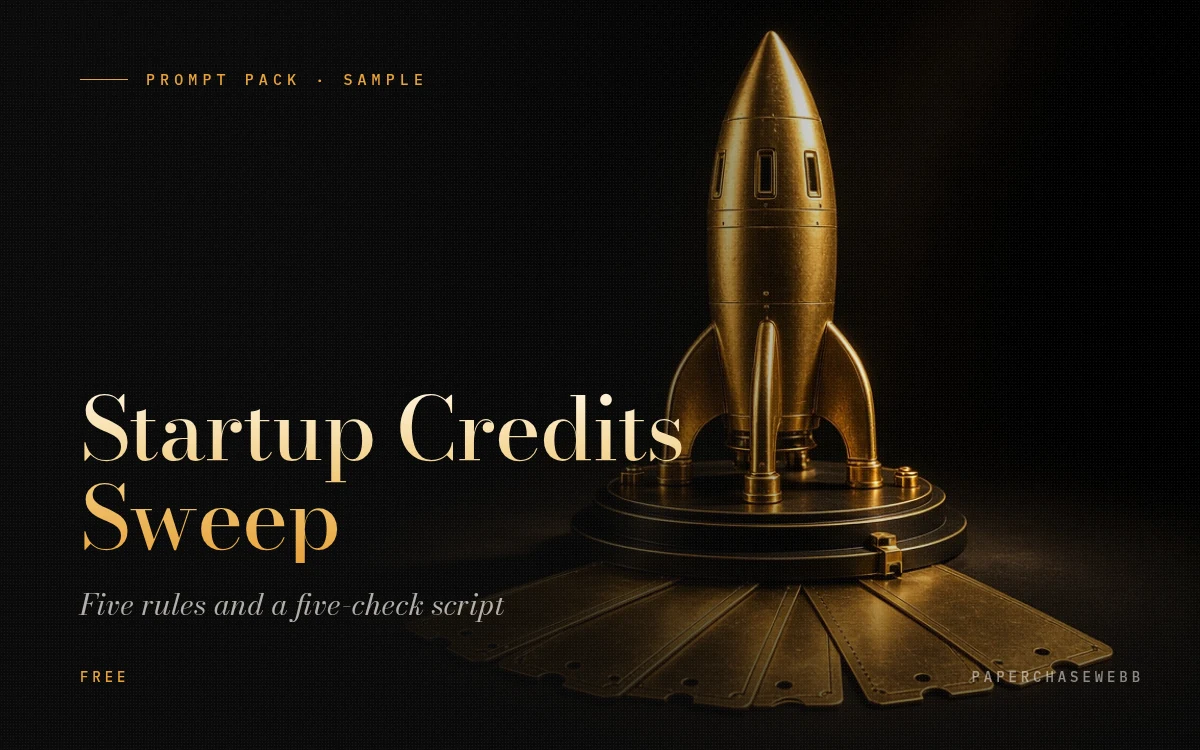
Startup Credits Sweep: five rules and a five-check script (free sample)
From the Startup Credits Sweep: five rules for going after startup credits honestly (facts first, the program's own dated page, apply only when every requirement is met, answers say your facts word for word, count credits only after approval and set a reminder before expiry), and a read-only script that checks one small file for them.

Research bundle: from first complaint to a decision you can defend, on one desk a script can check
Problem Mining Loop, Research Contract, Check the Claim and Compile Your Research in full, tied into one loop by a new Research Desk: every question names the decision it feeds, moves one stage at a time only when that stage's own checker exits 0, and draws on one shared register of sources with snapshots and claims with five verdicts. Someone who did no research audits before anything is compiled, fifteen read-only checks name every gap, and the owner's yes is typed at their own terminal and tied to the sha256 of the exact report.

Research Desk: five rules for research you will act on, and a five-check script (free sample)
From the Research bundle: five rules for research that feeds a decision (an owner and an auditor who did not do the research, a decision named for every question, one of five verdicts per claim, a date on every source, a primary source behind every CONFIRMED), and a read-only script that checks one small file for them.
AI Answer Visibility Check: does an assistant name you when a buyer asks, and who gets named instead
Ask each buyer question three times per assistant in fresh chats, paste the answers, and get a dated record of where you were named, where you were missed, who was named instead and which sources each answer cited. Fifteen read-only checks keep it honest: no brand in the question, three runs before a gap, answers hashed as given, nothing older than a month treated as current, and only your own brand. Page changes wait for the owner's yes.

AI Answer Visibility Check: five rules and a five-check script (free sample)
From the AI Answer Visibility Check: five rules for checking whether assistants name you (leave your name out of the question, a fresh chat each time, three runs before you call it, save the answer as it came, change your own pages with your own yes), and a read-only script that checks your saved answers.
Veteran GovCon AI Kit: capability statement, SAM.gov profile checklist and past performance with your agent
For veteran-owned and other small firms starting in federal contracting: a fact sheet your agent drafts from, eight prompts for a one-page capability statement, a SAM.gov profile checklist, a past performance skill, agency research prompts and capstat_check.py, thirteen read-only checks for UEI, CAGE and NAICS shape, hype words, placeholders, length and a dated source line for any status you list.

Capability statement ground rules and a five-line fact check (free sample)
From the Veteran GovCon AI Kit: the ground rules that keep an agent to your own facts when drafting a capability statement, and a five-line manual check for code shapes, contact details, hype words and dated status lines.
Consultant and Agency Skills Pack: discovery brief, scope, change request, client update and project close
Five installable agent skills in the Agent Skills format that carry one client engagement from first call to handoff, each drafting only from your notes with [ASK] for missing facts and never sending anything, plus skill_check.py, ten read-only checks on any skills folder against the spec and draft-only rules.
The scope-of-work skill and template (free sample)
One of the five skills from the Consultant and Agency Skills Pack: a scope-of-work skill with a template that gives every deliverable a done test and an out-of-scope list, drafts only and asks for missing facts.
Job Search Setup for Cursor or Claude Code: tailored drafts from your own resume, nothing submitted
Turn a folder into a job search workspace: an AGENTS.md with truth rules and hard nos, a master resume as the only source, a tracker, one folder per job, six prompts for fit checks, tailoring, cover letters and interview prep, and tailor_check.py, ten read-only checks that flag numbers, skills or roles in a tailored resume that are not in your master resume.

The job search AGENTS.md (free sample)
The rules file from Job Search Setup: truth rules that keep every claim to your master resume, and hard nos on applying, sending messages or logging in to job sites.
Small Business Social Agent Pack: a month of posts you approve row by row, exported for Buffer
Three installable skills (month plan, reply drafter, Buffer export), an AGENTS.md that forbids posting or logging in, a brand.md template and calendar_check.py, eleven read-only checks for Buffer's time format and headers, blank rows, image links, length limits, duplicates, hype claims, missing UTM tags and any exported post you did not approve.

brand.md and the month-plan skill (free sample)
Two pieces of the Small Business Social Agent Pack: the brand.md facts template and the month-plan skill that writes a month of posts into a spreadsheet with an Approved column only you fill in.

Give your Grok Bots office hours so questions wait for a briefing instead of interrupting you
A builder shared a prompt for a Chief of Staff bot that sorts every bot notification into urgent, decision and FYI, batches decisions into two daily review windows, rolls FYI into one end-of-day summary, and flags approvals that would expire before the next window.

Wake your bots on real work instead of a timer, and give each one its own read budget
A builder wiring seven Grok Bots into one launch workflow found hourly timers would mean over a thousand mostly empty runs a week. His fix: one scheduled check, every other bot woken by a trigger, a shared ledger for handoffs, a per-bot X read budget, a real dry-run mode and one spending bot behind a hard approval limit.

Write down your own call before your agent argues for one
Anthropic gave 50 professional analysts Claude Code with a hidden, coin-flip lean on four analysis choices. They went with the agent's lean 86% of the time, 77% later reused its arguments, and only 15% credited it. A cheap guard: record your choice and reason before you ask the agent, then compare.

Turn an official public source into a versioned git history, one agent session per source
A builder used separate Claude Code sessions, one per country, to download every version of each law from official publishers and write it out as git history with one commit per change on its in-force date. Each session checked robots.txt and the terms first, and two independent builds had to match hash for hash.